Punchy? Sure. It also promises something no dermatologist would promise, turns what might be a cosmetic cream into a drug in the eyes of the FDA, and hands a regulator a gift-wrapped complaint. Five words, three problems.
And the person reading it is usually someone who just noticed a raised scar creeping past an old piercing. They're Googling at midnight and ready to trust whoever sounds the most sure of themselves. That's why one of the most important medical copywriting tips is to prioritize accuracy and clarity over sounding confident.
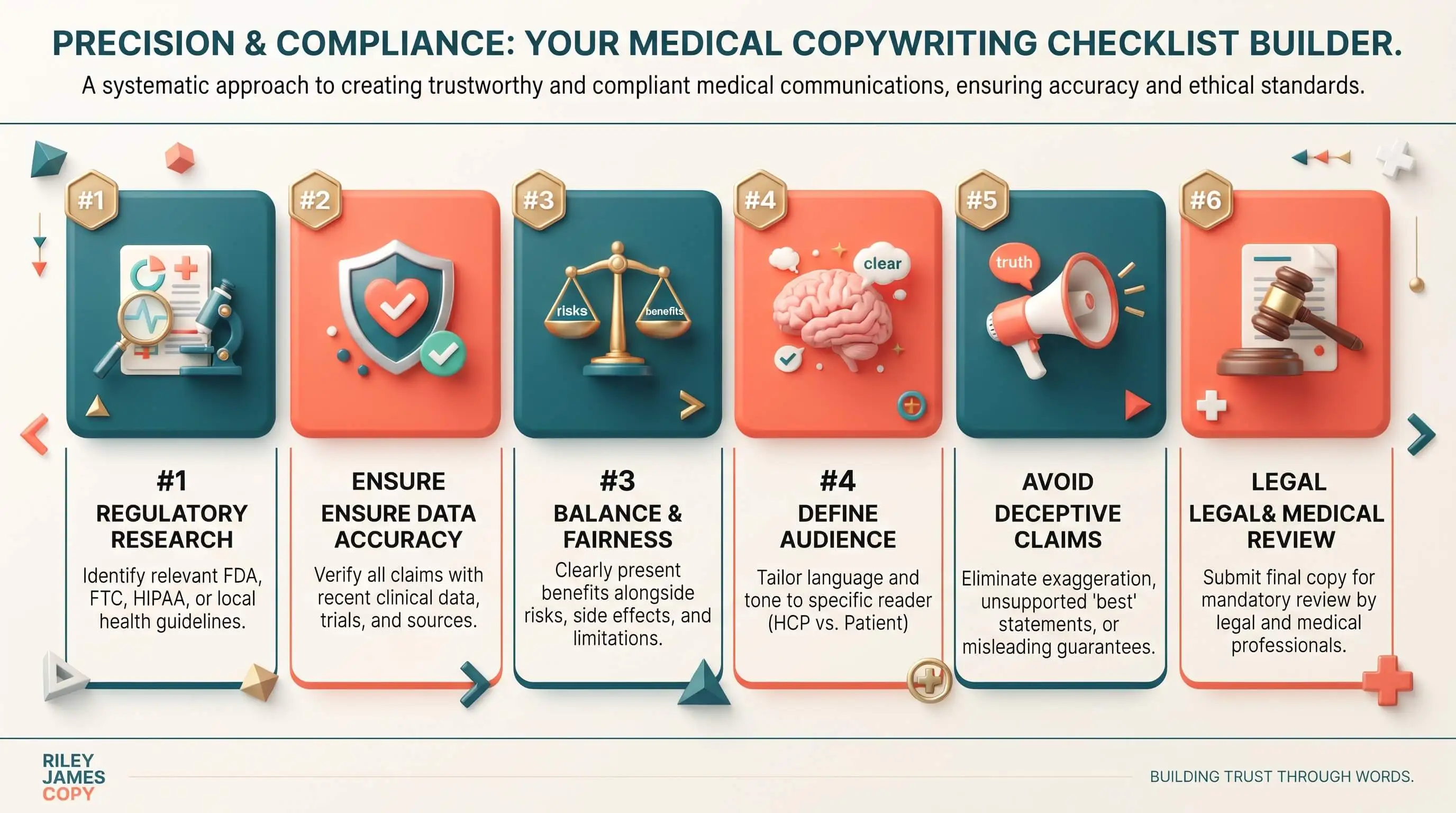
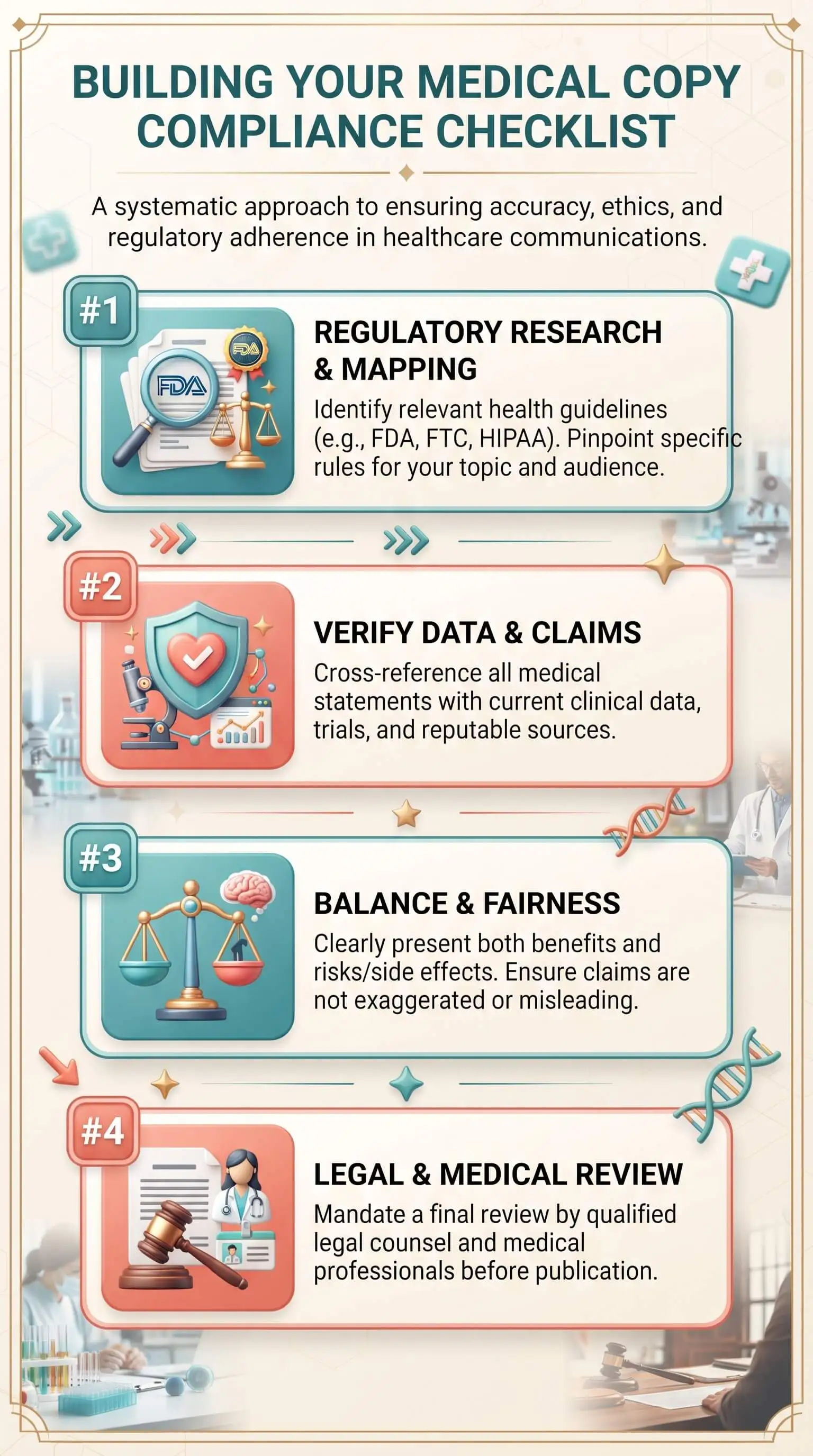
So how do you catch lines like that before they go live? You build a medical copywriting compliance checklist. List every claim in the copy, match each one to the rule that governs it (FTC, FDA, or HIPAA), attach a credible source, name who signs off, and put a date on the calendar to check it again. Then run EVERY draft through it before you hit publish.
TL;DR Quick Answers
Medical Copywriting Tips
The best medical copywriting tips boil down to one rule: write copy a worried patient can understand on the first read and believe all the way through. Clarity comes first, persuasion follows, and every claim has to hold up in front of a skeptical patient, a clinician, and a regulator.
Lead with the patient's worry, not your credentials.
Swap jargon for plain words a nervous reader can follow.
Back every claim with a named source. "Experts agree" proves nothing.
Cut "cure," "permanent," and "guaranteed" unless solid evidence supports them.
Get written HIPAA authorization before you use patient stories or photos.
Run a compliance checklist on every draft before it goes live.
Top 5 Takeaways
Back every claim with a source. If you can't find solid evidence for it, soften it or cut it.
Your words decide which rules apply. Under FDA rules, "improves the look of scars" and "treats keloids" are two very different claims.
Get permission for patient stories. Written HIPAA authorization comes before any testimonial or photo goes live, along with a note on typical results.
Tell readers what can go wrong. Being upfront that keloids can return after removal builds more trust than a perfect promise ever will.
Check before you publish, then check again later. A second reviewer plus a re-review date keeps last year's accurate page from turning into this year's problem.
What Is a Medical Copywriting Compliance Checklist?
Simply put, copywriting is a salesman who writes. Medical copywriting is that same salesman working for a clinic, a dermatology practice, or a skin-care brand, with a much stricter rulebook in his back pocket.
The compliance checklist is that rulebook boiled down to a handful of yes-or-no questions. Every piece of patient-facing copy has to pass them before it goes anywhere. If you've ever been in an OR, think of it as the surgical time-out for your marketing: everybody stops, confirms the basics, and only then does the work move forward.
Big pharma handles this with a formal medical, legal, and regulatory (MLR) review and a committee the size of a small wedding. Your practice probably doesn't have that. A good checklist gets a small team most of the protection with a fraction of the meetings.
Why Compliance Comes First
I've written a whole pile of medical copywriting tips about plain language and calls to action that get clicked. This is the one that comes with legal consequences.
Health content lives in what Google calls the "your money or your life" category, and for good reason. A misleading page about a skin condition can push someone toward the wrong treatment or talk them out of the right one. And when the copy crosses the line, it's the practice or the brand that answers for it, not the freelancer who typed it.
Here's the part most people miss, though. Compliant copy usually converts BETTER. Patients who've already been burned by a "miracle" cream can spot an overpromise like a dermatologist spots a suspicious mole.
How to Build Your Checklist in 6 Steps
Name the asset and the reader. A landing page for keloid injections carries different risks than a product page for silicone scar sheets, and both are different from a patient email.
List the rules that apply. The FTC covers your claims. Product wording can pull in FDA drug rules. Patient stories fall under HIPAA. Physician ads get the AMA's ethics guidance on top.
Highlight every claim. Grab a pen and mark each sentence that promises a result, compares you to someone else, or drops a number. You'll find more than you expect.
Attach a source to each one. If you can't find one, you soften the claim or you cut it.
Decide who signs off. Someone checks medical accuracy, someone checks privacy, and one person gets the final say.
Put a re-review date on it. Treatments change and so does the guidance. Every six to twelve months is a sane rhythm for most pages.
The 10-Point Medical Copywriting Compliance Checklist
Run every draft through these ten questions. One "no" means the copy isn't done yet.
Claims and Evidence
Is every claim truthful and backed by solid evidence? The FTC expects health claims to stand on competent and reliable scientific evidence before the ad runs, not after somebody files a complaint.
Did you cut "cure," "permanent," and "guaranteed"? Unless the evidence genuinely supports an outcome promise, it doesn't belong anywhere near patient copy.
Is the cosmetic-versus-drug wording right? The FDA decides based on intended use, and your claims are what reveal that use. "Improves the look of scars" reads as cosmetic. "Treats keloids" reads as a drug claim.
Did you disclose the risks and limits? If a keloid can come back after a doctor removes it, say so in plain words.
Privacy and Proof
Do testimonials and before-and-after photos have written patient authorization? HIPAA generally requires it before protected health information shows up in your marketing.
Is every bit of protected health information gone? Names, dates, and any detail that points back to one specific person need permission or need to go.
Do reviews show typical results and disclose incentives? The FTC's endorsement rules apply to your happiest patients too, especially the ones who got 10% off for leaving a review.
Clarity and Credibility
Would a nervous reader actually understand it? Plain words, correct terms. A keloid and a raised scar that fades on its own are two different animals, so get clear on keloids and hypertrophic scars before you write about either one.
Are your sources named and dated, and are credentials accurate? "Experts agree" proves absolutely nothing. A named agency or study does.
Does the call to action guide without shoving? A clear next step helps the reader, while fake countdown timers and scare tactics just push them away.
A Before-and-After Rewrite From Scar-Care Copy
Here's what the checklist does to the kind of lines I rewrite for skin and scar-care brands all the time:
Before: "Our cream permanently removes keloids." After: "Designed to soften and flatten the look of raised scars with daily use." Patients ask whether keloids can be cured permanently constantly, and the honest answer is a lot more careful than that ad was.
Before: "Guaranteed results in 2 weeks!" After: "Results take time and vary from person to person. Your dermatologist can tell you what's realistic for your scar."
Before: "Sarah's keloid vanished!" next to a photo with no signed release. After: the same story, shared with written authorization and a line about what results most people can expect.
Read those "after" lines again. Softer on paper, sure, but they're the ones a skeptical patient will believe.
Who Should Sign Off Before You Publish?
Writer: every claim has a source, the language is plain, and none of the banned words snuck back in.
Clinician: medical accuracy, correct terms, and honest risks and timelines.
Privacy or legal lead: HIPAA authorizations, product claims, and endorsement disclosures.
In a small practice, one person might wear two of those hats. Totally fine. Just make sure somebody other than the writer, including a freelance healthcare content writer, reads it before it goes live, because you will NOT catch your own overpromises.
"Before I touch a single word for style, I print the draft and go at it with a highlighter. I mark every sentence that makes a promise, and on most clinic pages that's a bigger chunk of the copy than anyone expects. Then I go hunting for a source for each one. Funny thing… The lines I can't back up are almost always the flashiest ones on the page. They're also the ones patients trust least. So the compliance pass rarely kills good copy. Usually it's how I find it"
Essential Resources
Seven things I'd bookmark before building your own checklist. Start with whichever one matches the copy sitting on your desk right now.
1. Know What Counts as Proof for a Health Claim
This is the FTC's own explanation of the evidence it expects behind health claims, including that "competent and reliable scientific evidence" standard. Checklist items one and two come straight out of it.
Source: FTC: Health Products Compliance Guidance
2. Handle Reviews and Testimonials the Right Way
When does a reviewer's free product need a disclosure? When does a glowing testimonial need a line about typical results? This FAQ answers both, in surprisingly readable English.
Source: FTC: Endorsement Guides, What People Are Asking
3. Learn Where Cosmetic Claims End and Drug Claims Begin
If you write about scar creams, gels, or silicone sheets, read this one twice. The FDA explains how a product's intended use, which your claims reveal, decides which rules apply to it.
Source: FDA: Is It a Cosmetic, a Drug, or Both?
4. Use Patient Stories Without Breaking HIPAA
HHS spells out when marketing that uses protected health information needs a patient's written authorization, along with the short list of exceptions.
Source: HHS: HIPAA Marketing Guidance
5. Keep Physician Advertising Honest
The AMA's opinion on advertising is short and makes a great gut check. Advertising is fine as long as it doesn't deceive anyone, and that includes testimonials that don't reflect what typical patients experience.
Source: AMA Code of Medical Ethics: Advertising & Publicity
6. Write So Real People Understand You
The federal plain language guides walk through writing, designing, and testing content for the people who'll actually read it. Healthcare copy lives or dies on this skill.
Source: Digital.gov: Plain Language Guide Series
7. Turn Clinical Detail Into Easy-to-Read Copy
MedlinePlus lays out how to plan, write, and test health materials, aiming for roughly a 7th or 8th grade reading level. Basically a medical content writing manual published by the government.
Source: MedlinePlus: How to Write Easy-to-Read Health Materials
Supporting Statistics
A few numbers that explain why the checklist looks the way it does. All from .gov or peer-reviewed sources, and none repeating the resources above.
1. Keloids removed with surgery alone come back in 45% to 100% of cases.
That range comes from a 2024 meta-analysis, and it's the exact reason "permanently removes keloids" fails the checklist. When the medical literature says a problem often returns, your copy doesn't get to pretend otherwise.
2. 58.5% of U.S. adults went online for health or medical information in the second half of 2022.
Your web page is often the first "provider" a worried patient meets. I write knowing that an honest claim earns their trust right there on the page, and an inflated one loses it for good.
Source: CDC/NCHS: Health Information Technology Use Among Adults, 2022
3. In the national health literacy assessment, 22% of U.S. adults scored basic and another 14% scored below basic.
So more than a third of your readers may struggle with dense health copy. That's why plain language sits on a compliance checklist at all. A disclaimer nobody can understand doesn't protect anybody.
Source: U.S. Department of Education (NCES): The Health Literacy of America's Adults
These statistics highlight why a copywriter Spokane WA healthcare providers can trust must prioritize evidence-based claims, accurate treatment information, and plain language, especially when research shows high keloid recurrence rates, widespread online health searches, and significant health literacy challenges among U.S. adults.
Final Thoughts and Opinion
Most of the compliance problems I run into come from enthusiasm with the brakes cut, not bad intentions.
A clinic gets great results and writes "guaranteed" because, from where they're standing, it feels true. A skin-care brand gets one jaw-dropping before-and-after and builds the entire page around it. Nobody set out to mislead anybody.
That's exactly why I bake compliance into the first draft instead of bolting it on at the end. When you write with the checklist open, the risky lines never land on the page in the first place, and you don't burn a week in review rewriting them.
So here's my opinion, plainly stated. Out of all the medical copywriting tips I could hand practice, this is the one I'd keep if I could only keep one. The copy that gets the appointment is the copy a worried patient can believe, and the checklist is how you get there.
One caveat, because I'd be a hypocrite without it: a checklist is a writing tool, not legal advice. If your copy makes drug claims, or you're unsure about a testimonial, loop in a healthcare attorney before anything goes live.
Frequently Asked Questions
Q: What Should a Medical Copywriting Compliance Checklist Include?
A: At minimum, evidence for every claim, zero cure or guarantee language, correct cosmetic-versus-drug wording, disclosed risks, HIPAA authorization for patient stories, honest testimonials, plain language, named sources, and a call to action that doesn't pressure anyone. Then add a sign-off step and a re-review date.
Q: Do Medical Copywriters Need to Know HIPAA?
A: Yes, at least the basics. You don't have to be a privacy lawyer, but you DO need to know that testimonials, photos, and patient details generally need written authorization before they show up in marketing. When in doubt, ask before you publish.
Q: Can I Say a Treatment "Cures" a Condition in Marketing Copy?
A: Only if solid scientific evidence backs it up, and for most skin conditions, keloids included, it doesn't. Describe what the treatment can realistically do, mention that results vary, and send readers to a clinician for advice on their own case.
Q: What's the Difference Between Cosmetic and Drug Claims for Skin-Care Products?
A: It all comes down to intended use, and your claims are what reveal it. Copy about improving how skin or scars look reads as cosmetic. Copy about treating, preventing, or changing how the body works reads as a drug claim, which brings stricter FDA rules along with it.
Q: What Are the Most Important Medical Copywriting Tips for Staying Compliant?
A: Source every claim, cut the overpromises, get permission before using patient stories, and write so a nervous reader can keep up. Then hand it to someone besides the writer for a second look. Those habits head off most problems before a formal review ever starts.
Ready to Write a Copy You Can Actually Stand Behind?
You can do that without a legal department, as long as you have the ten questions above and the habit of using them. These same principles apply to medical healthcare copywriting services, where every claim needs to be accurate, clear, and supported by reliable evidence. Copy the checklist, pin it next to your next draft, and run every single claim through it before you hit publish. Your patients will feel the difference, even if they never quite know why.


